South Asian Countries Gear Up for National IBF Demo on Temperature Hazards
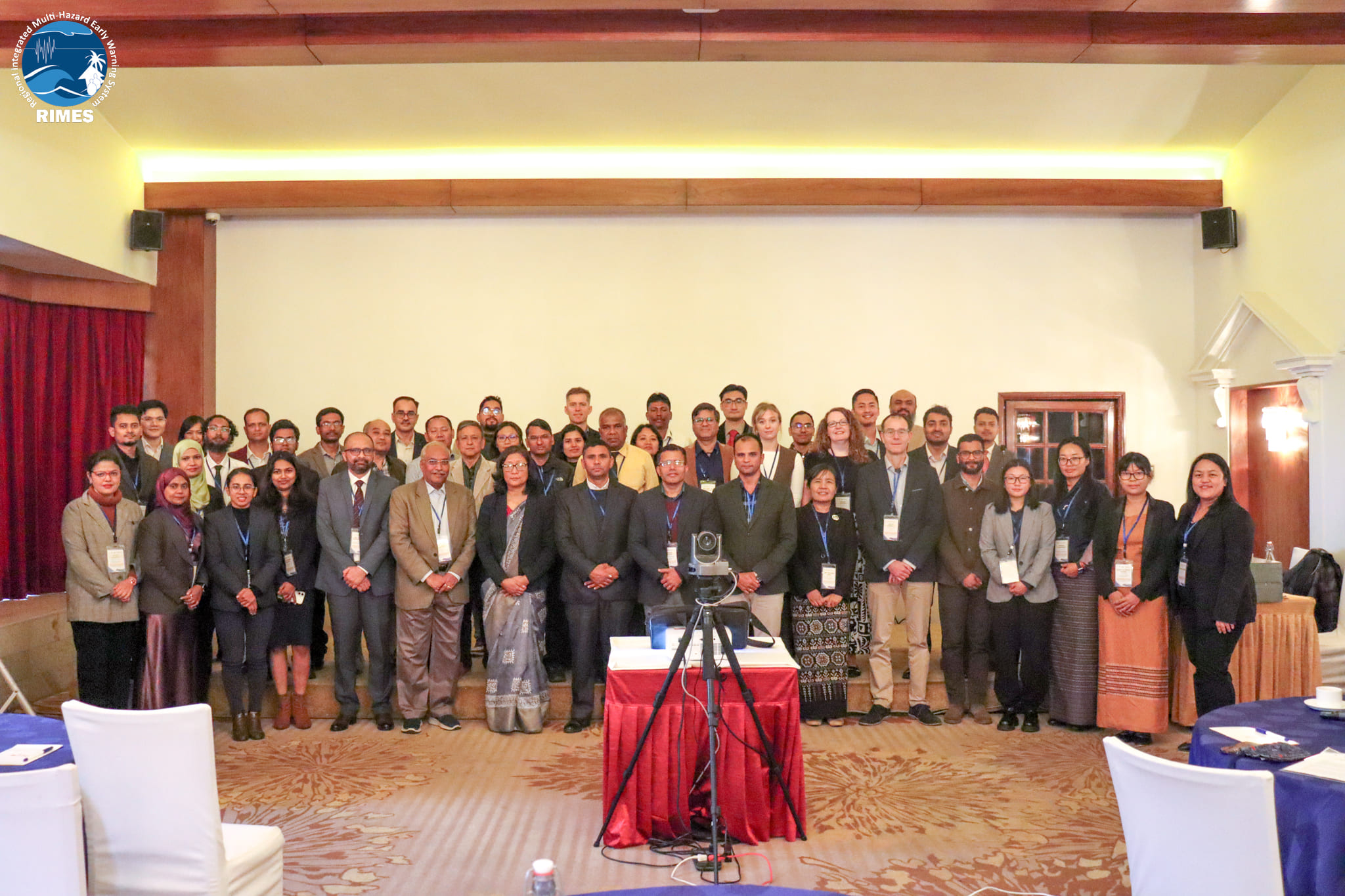
Participants from the 2nd Regional Workshop on Impact-Based Forecasting for Temperature-Related Hazards
KATHMANDU, NEPAL | 13 February 2026 – South Asian nations have finalized concrete national demonstration plans to operationalize Impact-Based Forecasting (IBF) for temperature-related hazards during the regional workshop on Training-of-Trainers and National Demonstration Planning in Kathmandu from 9–13 February 2026, marking a strategic shift from conceptual frameworks to applied operational practice.
The workshop brought together National Meteorological and Hydrological Services (NMHSs), national sectoral agencies such as health and disaster risk management authorities, and development partners from across the region. It was organized by the Regional Integrated Multi-Hazard Early Warning System (RIMES) in partnership with the UK Met Office under the SAHF IBF Implementation Plan Project supported by the UK government's Foreign, Commonwealth & Development Office (FCDO) through the Weather and Climate Information Services (WISER) Asia-Pacific Programme, a part of the Climate Action for a Resilient Asia (CARA) initiative.
Over the course of the week, participating countries—including Bhutan, Pakistan, Myanmar, Nepal, Bangladesh, Sri Lanka, Maldives, India, and Afghanistan—refined time-bound national IBF demonstration roadmaps. These plans include the establishment or strengthening of technical working groups, validation of heatwave thresholds using historical data, integration of cumulative heat stress approaches, and structured stakeholder workshops to co-develop sector-specific impact tables.
The initiative aims to strengthen people-centered early warning systems that connect forecasts with exposure, vulnerability, and sector-specific impacts—enabling earlier and more informed action in sectors such as health, agriculture, livestock, disaster risk management, water, and urban services.
“I hope that this project serves not only as an example to help address temperature related hazards and impacts for countries in South Asia but also provides a rich repository of learning to share with other regions tackling [temperature-related hazards] and also informing development of common approaches to impact-based forecasting,” remarked David Corbelli, Senior International Development Manager at UK Met Office, in his opening remarks underscoring the regional and global importance of the initiative.
Meanwhile, Dr. K.J. Ramesh, SAHF Adviser from RIMES, highlighted the strategic importance of the workshop, “This is a milestone event for SAHF—the developments that we have worked hard for in the past years will soon bear fruit as we advance towards implementing the national demonstration plans on temperature-related hazards.”
The workshop adopted a Training-of-Trainers (ToT) model designed to create a pool of national experts who can cascade IBF knowledge to sub-national actors and sectoral partners, ensuring the long-term institutionalization of these systems.
Technical sessions throughout the workshop focused on strengthening threshold and trigger methodologies, incorporating cumulative heat stress monitoring, aligning IBF with anticipatory action frameworks, and integrating Gender Equality, Disability, and Social Inclusion (GEDSI) and Monitoring, Evaluation, and Learning (MEL) mechanisms to support institutionalization and scaling.
These national demonstrations will serve as practical testing grounds to refine thresholds, validate impact matrices, strengthen NMHS–sector coordination, and generate evidence to support nationwide rollout. Countries committed to initiating stakeholder consultations, with several planning pilot advisories during the March–May 2026 heat season.
In his closing remarks, Mr. Barun Paudel, Senior Divisional Meteorologist from the Department of Hydrology and Meteorology (DHM), expressed the NMHS’s continued support to the project.
“As temperature-related hazards intensify across South Asia, our collaboration under the South Asia Hydromet Forum IBF initiative remains vital…This is not the end, but the beginning of our implementation.”
The workshop also reinforced alignment with the Early Warning for All (EW4All) initiative, positioning temperature-related IBF as a critical component of multi-hazard, multi-timescale early warning systems across South Asia.
RIMES and the UK Met Office will continue providing technical support, facilitate bi-weekly regional coordination meetings, and assist countries in cascading IBF training nationally. The 2026 national demonstrations are expected to generate actionable lessons to further strengthen regional climate services and disaster resilience.
---------------------
About the South Asia Hydromet Forum (SAHF)
The South Asia Hydromet Forum (SAHF) is a regional platform that strengthens collaboration among National Meteorological and Hydrological Services (NMHSs) and sectoral agencies across South Asia. SAHF advances climate services, impact-based forecasting, and early warning systems to support informed decision-making and disaster risk reduction.
About RIMES
The Regional Integrated Multi-Hazard Early Warning System (RIMES) is an intergovernmental organization dedicated to enhancing early warning capabilities and disaster resilience across Asia and Africa. RIMES supports countries in developing end-to-end early warning systems that integrate hazard science with impact analysis and risk-informed decision-making.
About WISER South Asia
The Weather and Climate Information Services for Resilience (WISER) South Asia programme, supported by the UK Foreign, Commonwealth and Development Office (FCDO), aims to strengthen the use of weather and climate information to reduce vulnerability and build resilience across the region.
For more information, visit: https://www.sahf.info/