Strengthening Last-Mile Communication and Flood Forecasting on a Shoestring Budget: Regional Workshop in Thailand
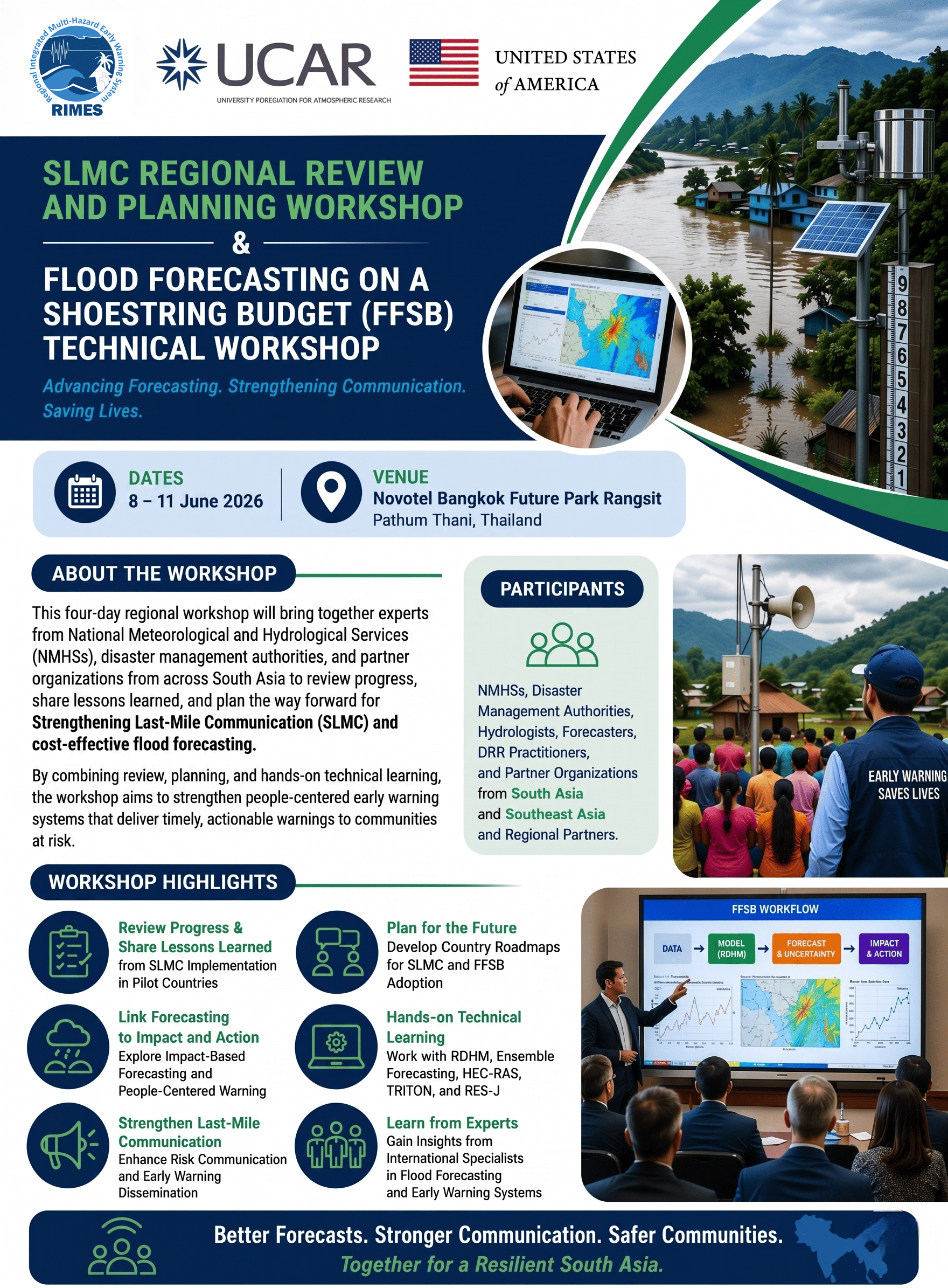
The Regional Integrated Multi-Hazard Early Warning System (RIMES), with funding support from UCAR will convene a Regional Review and Planning Workshop on Strengthening Last-Mile Communication (SLMC) alongside a Technical Workshop on Flood Forecasting on a Shoestring Budget (FFSB) from 8–11 June 2026 at Novotel Bangkok Future Park Rangsit.
This four-day regional event will bring together experts from National Meteorological and Hydrological Services (NMHSs), disaster management authorities, and partner institutions from South Asia and Southeast Asia. The workshop aims to consolidate progress achieved under the SLMC initiative and strengthen technical and operational capacities for delivering people-centered, impact-based early warning services.
The SLMC Regional Review and Planning Workshop will focus on assessing implementation progress across pilot countries, identifying key lessons learned, and developing actionable roadmaps for the continuation and scaling of last-mile communication systems. Discussions will emphasize strengthening end-to-end, people-centered multi-hazard early warning systems (MHEWS), enhancing institutional coordination, and improving risk communication strategies to ensure timely and effective dissemination of warnings to at-risk communities.
Complementing this, the FFSB Technical Workshop will provide a focused platform for advancing cost-effective and operational flood forecasting approaches. The sessions will cover key technical areas including ensemble hydrologic forecasting, forecast uncertainty, and the use of open-source tools such as the Research Distributed Hydrologic Model (RDHM). Participants will also engage in practical demonstrations and discussions on configuring forecasting systems, data preparation, and integrating forecasts into decision-making processes.
A key highlight of the workshop will be the participation of leading international experts in flood forecasting and early warning systems, who will contribute technical insights and global best practices. Their engagement is expected to strengthen regional capacity by bridging advanced forecasting methodologies with operational realities in resource-constrained environments.
The workshop is designed as an integrated platform to link advances in forecasting science with last-mile communication systems, ensuring that improved technical capabilities translate into actionable early warnings and timely community response. By the end of the workshop, participating countries are expected to develop country-specific action plans outlining pathways for strengthening impact-based forecasting and enhancing early warning dissemination. The workshop is also meant to promote the establishment of the FFSB open-source hydrological forecasting community to further low-cost operational ensemble flood forecasting.
This regional initiative reflects RIMES’ continued commitment to supporting its Member States in building resilient, inclusive, and effective early warning systems that save lives and reduce disaster risks.
For more information, please contact us through our email: rimes@rimes.int.